
For a small SaaS or ecommerce team, the same twenty or so questions come back every week: order status, account access, billing, returns. An AI agent like Intercom’s Fin can absorb part of that load, as long as you don’t plug it in blindly. Here are five steps to get there: diagnose, prepare sources, define human handoff, run a pilot, measure. The technical points rely on Intercom’s official documentation, linked throughout.
Disclosure: this article contains AI Hunter affiliate links. If you subscribe through them, we may earn a commission at no extra cost to you.
1. Diagnose the repetitive work
Before choosing any tool, export 100 to 200 recent conversations and sort them by type. Shortlist the requests that meet four criteria: the answer is stable, it already exists in writing, it needs no action in a back office, and a mistake is cheap.
Illustrative customer questions:
- “Where is my order?” (a candidate only if the answer fits a public rule, otherwise it needs access to order data)
- “How do I reset my password?” (good candidate)
- “What are your delivery times to Belgium?” (good candidate)
- “I want a refund, you charged me twice.” (human)
If your export shows no recurring theme with an identical answer, there is little for automation to handle. Better to learn that before paying for a single seat.
2. Prepare trustworthy knowledge
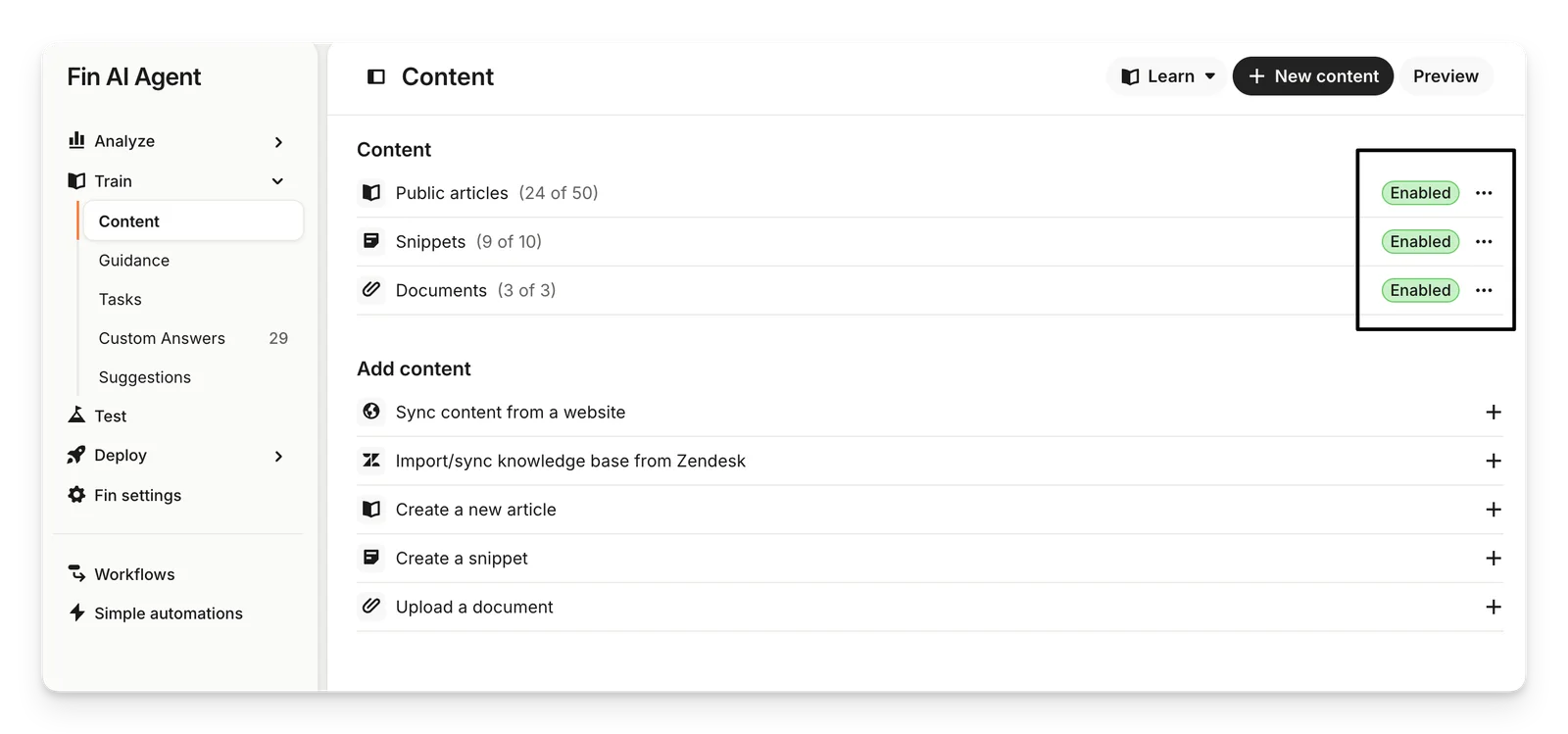
Fin answers from what you give it. According to the chat deployment guide, the Messenger must be installed for chat, and current instructions require at least 10 public Help Center articles live. Content is managed in Fin AI Agent > Train > Content, which accepts public articles, documents, snippets and public URLs. You can configure guidance on voice, policies and sensitive topics with handoff to a human. Intercom says to test before deploying, using either a simple deployment or more advanced Workflows.
Per the Fin FAQ, French, English, German, Spanish and Portuguese are supported, an active plan or trial is required, and a content import can take from 10 minutes to 10 hours. Plan the import before your test.
To prepare your sources:
- Write one article per question, with the exact rule (deadline, condition, exception) and a review date.
- Remove or fix contradictory content before importing: conflicting sources increase the risk of a wrong answer.
- If you serve several languages, review each one separately.
A question to ask Intercom before committing: which integrations (store, CRM, billing) and which actions, such as a refund, can Fin perform in your setup?
Three before/after examples
These examples are illustrative: the values (delays, days) are invented to show the level of precision to aim for, not rules to copy.
Example 1: the “rule” field of a delivery article.
- Before: title “Shipping”, text “We deliver quickly throughout Europe.”
- After: title “What are your delivery times to Belgium?”, rule “3 to 5 business days after dispatch”, exception “no Sunday delivery”, last review “2026-11-01”.
- Why: Fin can quote a specific rule and its condition instead of rephrasing a vague promise.
Example 2: two articles that contradict each other.
- Before: one article says products can be returned within 14 days, another says 30. Fin has two versions for the same question.
- After: a single article “How long do I have to return a product?” with the correct window, the other deleted or redirected.
- Why: one source per question lowers the risk of a wrong answer.
Example 3: the pilot owner’s action on a human handoff.
- Before: Fin hands a conversation over because it can’t find the answer, nobody records why, and the same question comes back three days later.
- After: the owner logs each handoff in a sheet (date, theme, reason), writes the missing article within the week, and replays the question in testing.
- Why: every handoff becomes a knowledge base improvement instead of a plain failure.
3. Define the human handoff
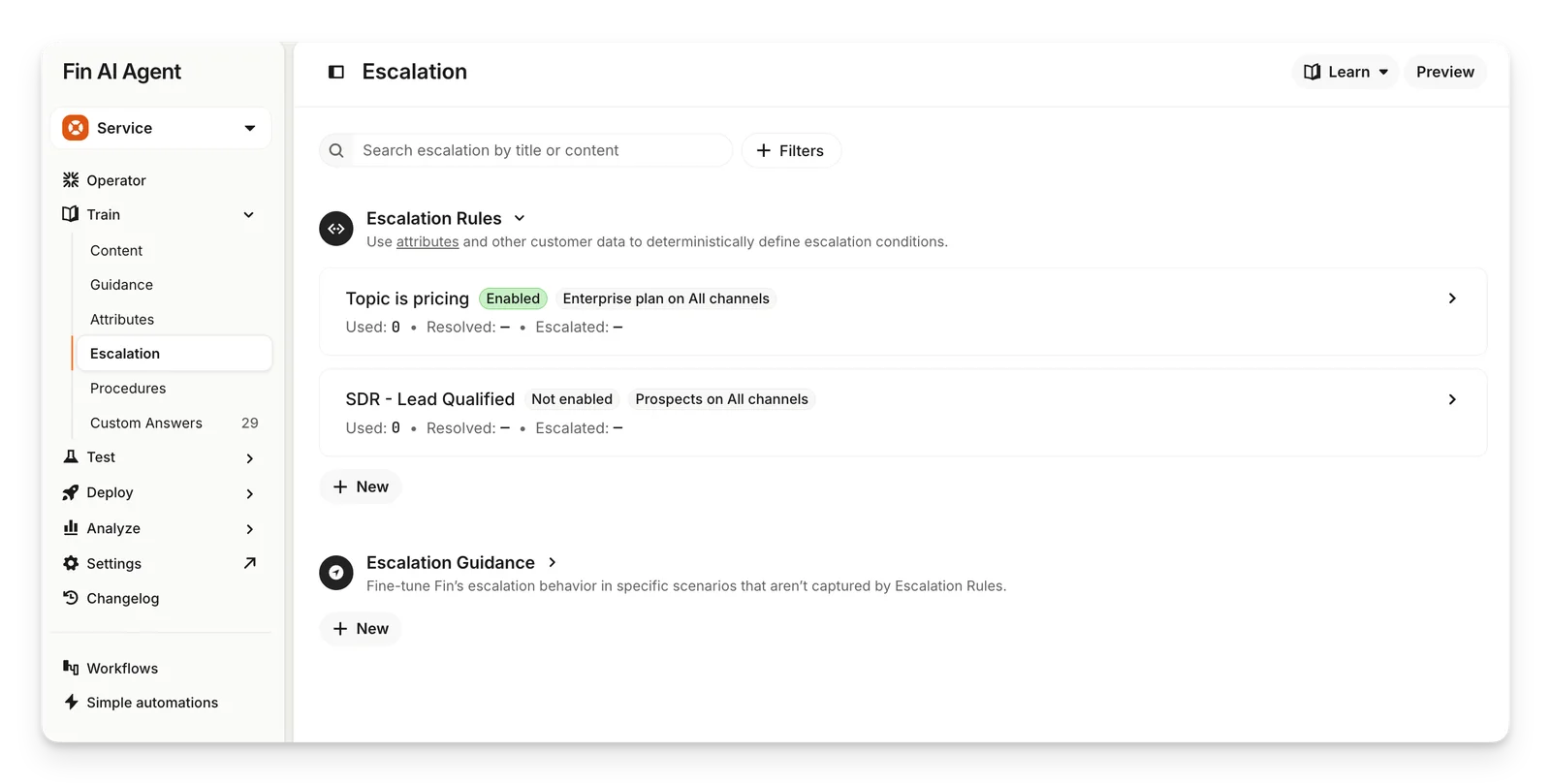
Control is won or lost here. Write the rules before the pilot, not during it. Here is a starting point to adapt:
| Trigger | Action |
|---|---|
| Customer asks for a human | Immediate handoff, no pushback |
| Two answers and the customer is still unsatisfied | Handoff with a conversation summary |
| Anger, threat to cancel, legal mention | Priority to a human |
| Refund, payment dispute, double charge | Human, no promises from the AI |
| Account security, identity, personal data | Human only |
| Question missing from the knowledge base | Handoff, then write a new article |
Intercom provides guidance settings for sensitive-topic handoff: configure them, then check in testing that each rule actually triggers.
4. Run a controlled pilot
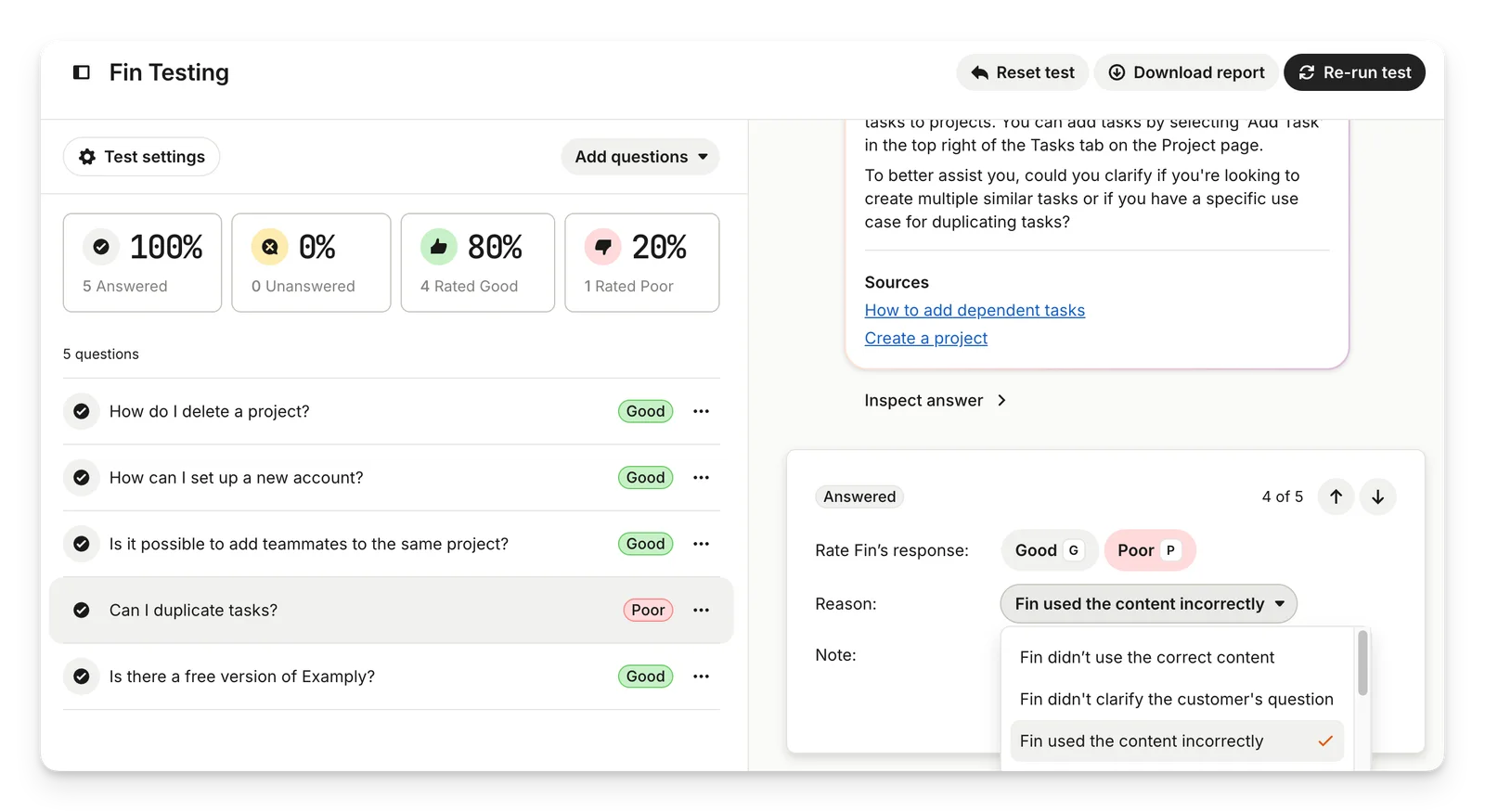
For a first pilot, we suggest two weeks, one channel (chat), three to five themes and at least 50 conversations reviewed before you decide. Before opening to the public, replay the 12-test grid: each row gives the question, the expected behavior, whether a handoff is expected and the pass criterion. During the pilot, review a sample of conversations every day.
To decide, look at three things: no serious error on payment or security, human requests always honored, and a large majority of answers judged accurate on review. Set your own threshold in advance, for example 90%, and write it down before day one.
5. Measure cost and quality
According to the page on Fin outcomes, for chat and email with Intercom, at most one outcome is billed per conversation. Prices: resolution $0.99, handoff through a configured Procedure $0.99, disqualification $0.99, qualification $9.99, self-serve routing $0.99. A resolution can be confirmed or assumed when the customer asks for no further help after the last answer. Not every escalation is necessarily chargeable: check the cases on the page. Usage alerts and limits are available.
Two practical consequences: set a usage limit from the start of the pilot, and review assumed resolutions first, because a customer’s silence is not proof of satisfaction.
On the subscription side, the plans page lists Essential at $39 per seat per month billed monthly ($29 billed annually). Fin usage is extra.
Calculated example (illustrative, not a quote): 2 Essential seats billed monthly plus 300 resolutions. 2 × $39 = $78, 300 × $0.99 = $297, for $375 per month. This total excludes other charges, taxes and other outcome types.
To judge the result, record four numbers separately: total pilot cost, number of billed outcomes, accuracy measured on your reviewed sample, and the share of conversations handed to a human for a good reason. Avoid dividing the full cost by only the correct cases in the sample: the sample doesn’t cover every conversation, so the ratio would be distorted.
Explore Intercom’s Fin and its plansIs Fin right for your team?
| Your situation | Verdict | Why |
|---|---|---|
| At least 10 reliable public articles and repetitive questions | Pilot makes sense | Content prerequisites are met |
| Low conversation volume | Run the numbers | Compare the time saved with the monthly budget (seats plus resolutions) before starting |
| Outdated or contradictory help content | Fix it first | No reliable source, no reliable answers |
| Most requests need an account action | Verify | Ask Intercom about integrations and actions |
| Customers in French, English, German, Spanish, Portuguese | Possible | Languages supported, test each one |
| Regulated or sensitive topics | Cautious pilot | Strict human handoff rules |
FAQ
Do we need a large team to start? No, but you need repetitive volume and reliable content. Without either, postpone the project.
How many articles do we need? For chat, Intercom’s current instructions require at least 10 public articles live. A few accurate articles beat many vague ones.
Does Fin bill every message? According to the documentation, billing is per outcome, at most one per conversation for chat and email with Intercom. Check the official page for specific cases.
Can Fin refund a customer or change an order? Check the actions available for your setup, the permissions and the approval rules before automating a refund.
Can it work in several languages? Among the supported languages are French, English, German, Spanish and Portuguese. Test each language with your own content.
Take the next step
Start with the conversation export and the twelve-test grid, then open a short pilot with written escalation rules. If you want to try it, here is the link: try Intercom’s Fin.
Compare the options in our AI ecommerce customer support guide.
Tools mentioned
Find the best AI tool
215 tools listed with features and pricing. Find the one that fits your needs.