
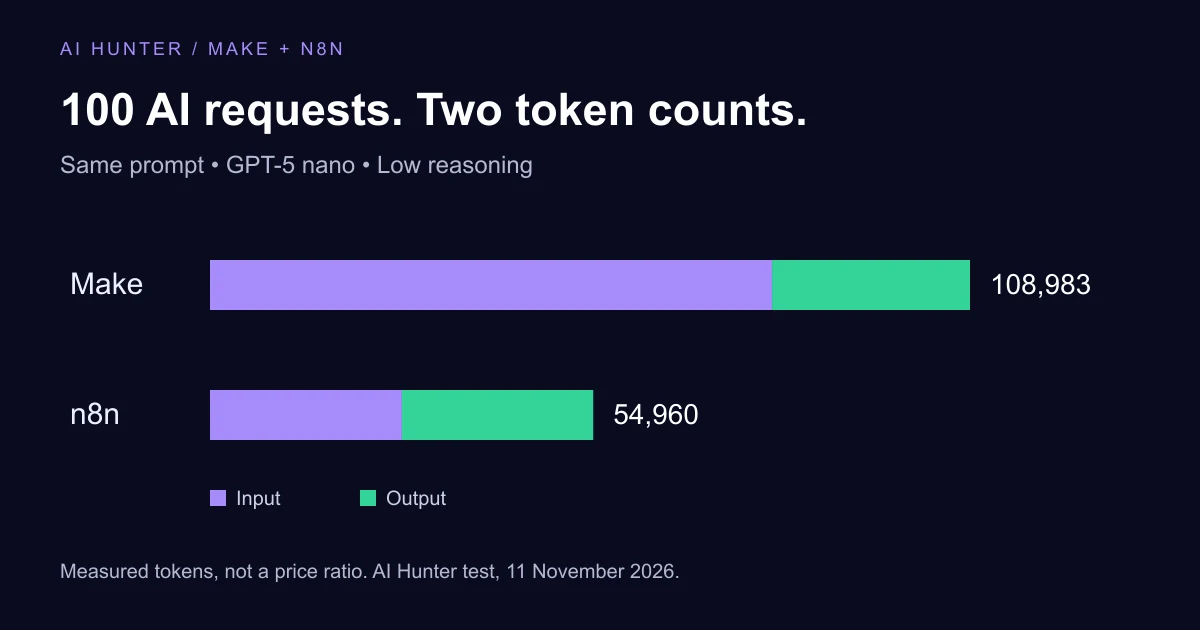
You want to sort incoming requests for your agency or small business automatically and prepare a draft reply for each one. The plan price on the Make or n8n website won’t tell you what 100 processed requests cost. On November 11, 2026, we ran the same 100 requests through both platforms on real connected accounts (Make Free and an n8n Cloud trial), using the same nominal model: GPT-5 nano with reasoning set to low. Both classified all 100 requests correctly. What they counted was very different.
Make used 117.98 credits and ended with a timeout warning, though it still delivered all 100 outputs. n8n succeeded in about 4 min 17 s, in a single execution, using half as many tokens in total. None of these figures on its own tells you which tool is cheaper. Here is what they do help you decide.
Affiliate link: AI Hunter may earn a commission if you subscribe through this link.The task: classify and draft, not run an agent
Each request is a short customer message. The model has to return a JSON object with the request ID, a category, a recommended action and a draft reply. Four intents were repeated 25 times each: a documentation request, a demo request, a pricing or discount question, and a help request too vague to fit anywhere else.
Nothing touched a live inbox or CRM. The test sends nothing, schedules nothing and calls no tools. It is a classification-and-draft workload running on each platform’s AI agent infrastructure, not an autonomous agent choosing its own actions. Every request got one model call, with no memory and no reused conversation.
The settings were aligned. Both workflows used the same system prompt, checked in their exports. Output was capped at 25,600 tokens (in Make, 20% of the 128,000 the interface offers). JSON was requested in the prompt text rather than through a provider JSON mode. In Make, a Repeater module generates the 100 items and an agent module processes each one. In n8n, an OpenAI Message Model node goes through the n8n AI gateway, followed by a code node that validates the output.
Validation happened outside the platforms. Make outputs were downloaded and checked separately. All 100 n8n rows were read from the results table and checked the same way. We verified the ID, the presence of each field, the category and the action. The drafts were not fully reviewed by a person, so this is a compliance check, not a general quality evaluation.
Observed results
| Metric |  Make |  n8n |
|---|---|---|
| Exact classification | 100/100 | 100/100 |
| Status | Warning: 5 min limit reached | Success |
| Displayed duration | 5 min (rounded) | About 4 min 17 s |
| Platform counter | 101 operations, 117.98 credits | 1 manual execution, 100 calls |
| Input tokens | 80,600 | 27,525 |
| Output tokens | 28,383 | 27,435 |
| Total tokens | 108,983 | 54,960 |
Neither platform served any tokens from cache.
Credits, executions, tokens: what each counter measures
Make counts credits. According to its documentation on AI agents, an agent operation using the Make AI Provider costs 1 credit plus credits based on tokens. Paid plans can also connect your own provider, in which case the model is billed separately. In our run there were 101 operations (100 agent calls and 1 Repeater), with 116.98 credits for the agent and 1 for the Repeater. That makes 117.98 credits, or 1.1798 credits per correctly classified request, all within the free quota.
n8n counts executions. Its pricing page bases subscriptions on monthly workflow executions, with unlimited steps. Our run was one manual execution containing 100 items and 100 model calls. Model usage through the gateway is a separate line. Don’t confuse it with AI Assistant credits, which, according to n8n support, cover conversations with the workflow-building assistant, not model calls at runtime.
For the model cost on n8n, the gateway interface shows cumulative account spend as a rounded total: USD 0.01 after the baseline check, the pilot and the 100-request run combined. The exact charge for the 100-request batch is unknown. It would be wrong to say that 100 requests cost one cent.
Five minutes on Make: a warning, but 100 outputs recovered
The Make scenario ended with a Warning status after hitting the 5-minute maximum execution time. The displayed 5 min is rounded. Even so, all 100 outputs were exported complete and passed validation. So this was neither a fully successful workflow nor 100 lost outputs.
The practical takeaway is that at this volume, with this model, the batch is close to the ceiling. A larger batch or a slower model could be cut off partway through. If you plan to use Make for batch processing, split your batches, watch each execution’s status, and treat a Warning as an alert, not a success. We did not rerun the scenario to get a cleaner status.
Why the token gap does not prove overbilling
Make recorded 108,983 tokens and n8n 54,960. The gap, roughly two to one, comes mostly from input tokens (80,600 versus 27,525). Output tokens were close (28,383 versus 27,435).
We did not isolate the cause. The system prompt was identical, but differences in execution paths and internal platform settings could contribute to the gap; this test does not establish their role. The model is nominally the same: n8n returns the dated version gpt-5-nano-2025-08-07, while Make does not expose its version. These numbers therefore do not show that Make bills double or costs twice as much. Make credits and a rounded gateway spend can’t be turned into a price ratio, and this test does not support any ranking by cost.
The prompt fix before scaling up
A first three-request pilot exposed an error on Make: the pricing question was classified as unknown, although the draft did not invent a price. We corrected the prompt on two points. A pricing intent stays a pricing intent even when the price is unknown, and a person confirms demo requests. The new pilot scored 4/4 on both platforms, and the volume run 100/100.
With samples this small, we can’t credit all of the improvement to the prompt. The pilot still did its job: with just a few calls, it caught an ambiguity that could have repeated across a whole batch.
One batch of 100 or 100 triggers
Our 100 requests ran through a single workflow. In production, messages often arrive one at a time, and each one triggers its own run. That changes the bill. As an illustration:
- on n8n, 100 items processed in one execution count as one execution, while 100 separate triggers count as 100 against your monthly quota;
- on Make, credits follow operations, so each trigger adds the operations of its own modules on top of the agent calls.
Our run was manual, and we don’t claim it was counted the way a production execution would be. After a few real triggers, check the usage counter in your own account. Batching cuts the number of executions, but it delays replies and, on Make, brings you closer to the 5-minute limit we hit here.
How to choose for your situation
The right measure is neither the plan price nor the token count. It is the cost per accepted result: (share of subscription allocated to this workflow + model usage + other services) ÷ number of accepted results. Add the time spent monitoring runs, fixing prompts and handling warnings.
- Requests arrive one by one at modest volume and your team already knows Make: credits per request are easy to read, but keep an eye on token usage and scenario duration. Our full Make review covers the rest.
- You can group requests into batches: n8n’s per-execution model fits that pattern, as long as you track model spend separately. See our n8n review.
- You want to pay your model provider directly: Make allows this on paid plans, and you then have two bills to add up.
This test covers one task, one model and one day. It says nothing about how fast or reliable either tool is on other workloads. We bought no subscription for it, and the free credits we used don’t prove that running this in production would be free.
Rerun the test with our files
- requests-100-v2.csv: the 100 input requests
- instructions.txt: the instructions sent to the model
- results.csv: outputs and checks for each request
- summary.json: aggregated metrics
The inputs are the four synthetic requests repeated 25 times. Outputs and metrics are included, with no personal data. These files reproduce a classification-and-draft workload. They are not a validated end-to-end agent and contain no email sending or scheduling actions.
Frequently asked questions
Does Make use twice as much as n8n?
In this test, Make recorded about twice as many tokens, mostly on input. The cause was not isolated and the billing units differ, so you can’t conclude that Make costs twice as much.
How much did the 100 requests cost on n8n?
The exact amount is unknown. The n8n gateway interface shows rounded cumulative account spend of USD 0.01, and that total also includes the baseline check and the pilot.
Can I run this workflow in production on a free account?
The test fit within Make’s free quota and the n8n Cloud trial, but that guarantees nothing for ongoing use. Work out your cost per accepted result on a pilot before you pick a plan.
Next step
Write four requests that represent your own inbox, one per intent, and run them through both tools with the same prompt. Fix the prompt if a classification goes wrong, then run a pilot batch and record credits, executions, tokens and status before you commit to a plan.
Related guides
Comparisons and guides covering adjacent topics.

Best AI No-Code Automation Tools in 2026: Make vs Zapier vs n8n vs Activepieces
Make, Zapier, n8n, Activepieces and Lindy compared: the best no-code automation tools in 2026 covering workflows, AI orchestration, self-hosted and agentic execution.

Make vs Zapier: Which Automation Tool in 2026?
Make or Zapier? Detailed comparison of the two no-code automation leaders: pricing, features, ease of use, and when to use n8n instead.
Codex Micro: why AI agents now have their own keyboard
Codex Micro, the $230 keyboard from OpenAI and Work Louder, shifts the focus from prompting to supervising AI agents. Analysis, use cases and limits.
Find the best AI tool
215 tools listed with features and pricing. Find the one that fits your needs.