
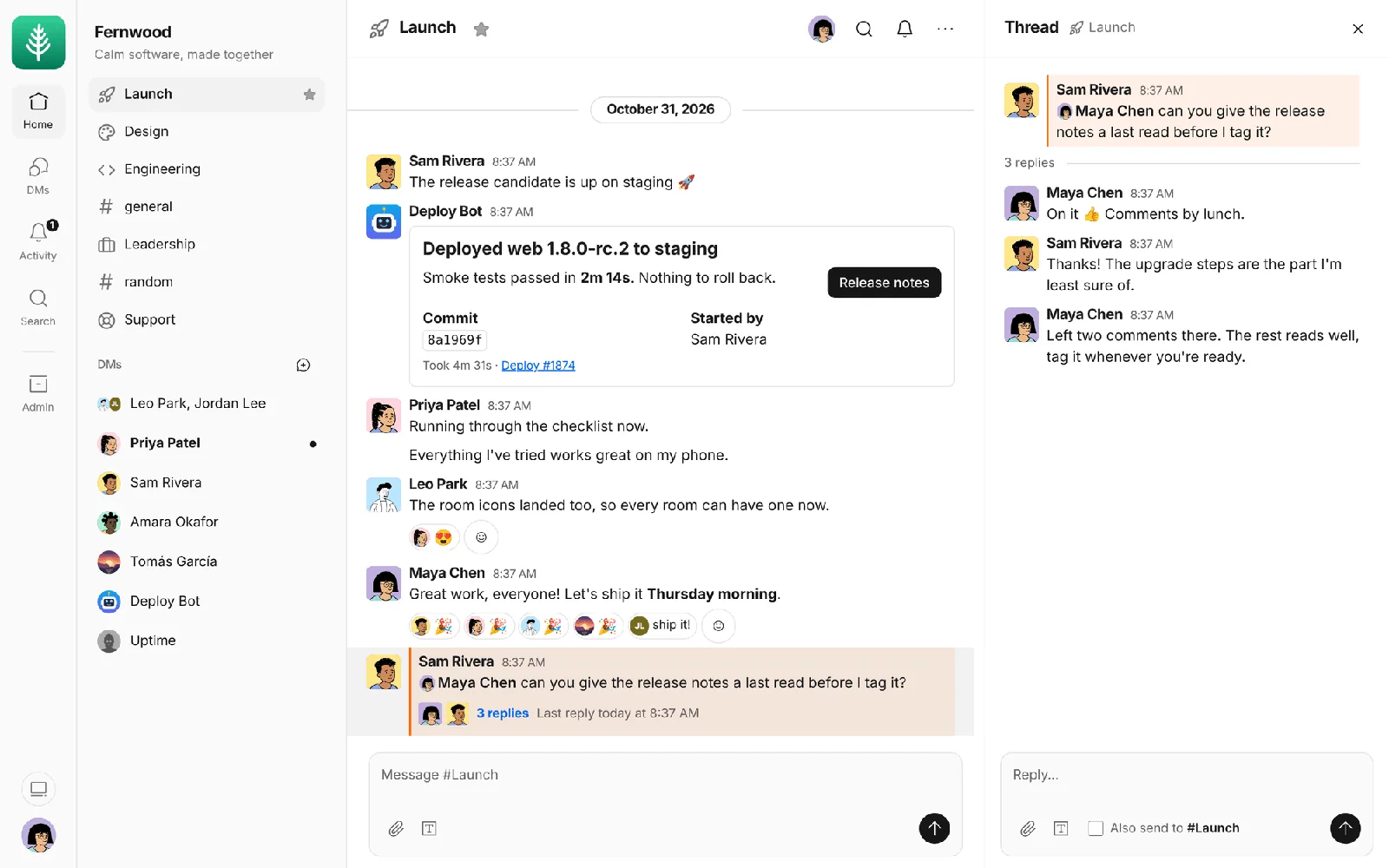
For years, a team chose its messaging tool from among several subscriptions. Ember offers another path: take the code and deploy the application on your own cloud account. This small project does not, on its own, replace the full depth of Slack. Yet it raises a question that goes far beyond chat: how much of what we pay in subscriptions still buys software that is hard to reproduce?
Ember: team messaging you host yourself
The official Ember repository describes a messaging app inspired by Slack and Campfire. It is released under the MIT license and designed to run on the user’s own Cloudflare account. The announced scope covers channels, threads, direct messages, files, search and bots. The README also mentions configurable AI agents and Slack-compatible webhooks. It acknowledges gaps compared with Slack, notably around calls and the app ecosystem. The project was launched on Product Hunt.
Two caveats apply. The infrastructure cost of such a project is not its total cost: storage, usage, model calls, administration and migration come on top. Moreover, hosting on Cloudflare does not eliminate technical dependency. It simply shifts from an application vendor to an infrastructure provider. Ember therefore does not prove an economic upheaval. It is a clear signal of a broader movement.
Getting “open-sourced”: three realities behind one phrase
The phrase is convenient but misleading. It does not mean that Slack, Salesforce or DocuSign have published their code. It covers at least three phenomena, which do not expose a vendor in the same way.
The first is genuine opening: a vendor publishes its own software. This is the case with Campfire, which Ember claims as its lineage. In March 2026, DHH explained the opening of the code of Campfire, Writebook and Fizzy, as well as the evolution of the ONCE project. The Campfire code is available on GitHub.
The second is the independent alternative: an open project covers use cases close to those of a proprietary product. It is neither that product’s code nor a guarantee of feature parity.
The third is internal rebuilding: a team adapts an existing project, or uses an assistant to generate the small tool it needs, and keeps it to itself. There is no public repository and no new commercial competitor. This path is less visible than a new commercial competitor. Yet it may be the one that weighs most heavily on certain subscriptions.
Open competition already exists
Ember arrives in an already crowded landscape. Several of the projects below predate the current wave of agents. They show that the open foundation exists, not that AI created it. They point to categories exposed to documented competition, not to lost revenue.
| Established product | Open alternative | What the example shows |
|---|---|---|
 Slack |  Ember  Campfire | Part of the messaging need can be served by open code |
 Salesforce |  Twenty | Explicitly presents itself as an open alternative for CRM (license) |
 Jira  Linear  Monday  ClickUp |  Plane Community | Open project management, alongside a separate, closed Commercial edition (documentation) |
 DocuSign |  Documenso | Electronic signature under the AGPL, with a commercial edition (licenses) |
 Intercom  Zendesk |  Chatwoot | Open customer support, though not every AI or enterprise feature is necessarily open source |
 Airtable |  Baserow | Self-hostable collaborative database, whose commercial scope should be kept distinct |
 Notion |  AppFlowy | Open documentation workspace, without an equivalent for every feature |
 Qualtrics |  Formbricks | Open feedback collection, openly positioned against Qualtrics |
What these projects have in common is not that they are free. Several of them rely on a hybrid model: an open community edition, a paid hosted version and advanced features held back. Open code serves as a competitive argument. It almost never means giving up revenue.
What agents change in the equation
These alternatives existed before coding assistants. Our Claude Code vs Codex comparison helps place the tools that support this work today. In our analysis, what changes is the entry cost of putting them to use. Building a prototype, adapting an open project to internal rules or writing a connector to an existing tool could call for technical skills that were hard to free up internally. These tasks are becoming accessible to more organizations, provided human oversight is maintained.
The available measurements call for caution. Anthropic classifies 79% of Claude Code conversations in its April 2025 sample as automation. This is a usage indicator: it does not mean 79% more productivity, nor eliminated jobs. In the other direction, METR observed in early 2025 a 19% slowdown among experienced developers working on repositories they knew well. In its February 2026 update, METR considers its new estimates hard to interpret because of selection bias. None of these studies makes it possible to put a figure on what a company gains by rebuilding a tool.
The reasonable conclusion is more modest. Agents shift the line between “buy” and “build” for certain tasks and in certain contexts. The gain depends on the quality of the starting project, the clarity of the need and the person who reviews the output.
The most serious competitor could be the customer
This is where the thesis becomes serious for a vendor. A small team uses neither all of Salesforce nor all of Slack. It relies on a few workflows: tracking a sales pipeline, chatting in three channels, getting a standard contract signed. An alternative does not need to match the entire product to become viable. It only has to cover that subset well.
This changes the nature of the risk. A vendor usually compares itself with competitors of similar size, feature by feature. Yet for part of its customer base, the most plausible substitute may not be another vendor. It is a customer with an open project, a cloud account and a coding assistant. This substitute does not target the whole product, only the share of the price that pays for generic features.
The limits remain real. Fine-grained permissions, connectors, business rules, history and habits must be checked team by team. But the question facing SaaS changes: it is no longer whether the product can be copied, but whether the part the customer actually uses can be.
An interface can lose its value before its backend
One hypothesis takes this reasoning further. An AI agent can chain actions across several tools, instead of just producing an answer. Suppose an agent becomes a team’s shared entry point and queries the CRM, the messaging tool and the ticketing tool on its behalf. Each application’s interface then captures attention less directly. The software remains useful for its data and for the actions it enables. But it becomes a building block you call, more than a place where you work.
This effect cuts both ways. It can weaken small, redundant tools that stood out only for their ergonomics. It can also strengthen well-integrated platforms that are able to expose reliable actions and robust authorizations. A connection protocol is not enough: establishing who is allowed to do what, and being able to prove it, remains the vendor’s job.
What remains hard to copy
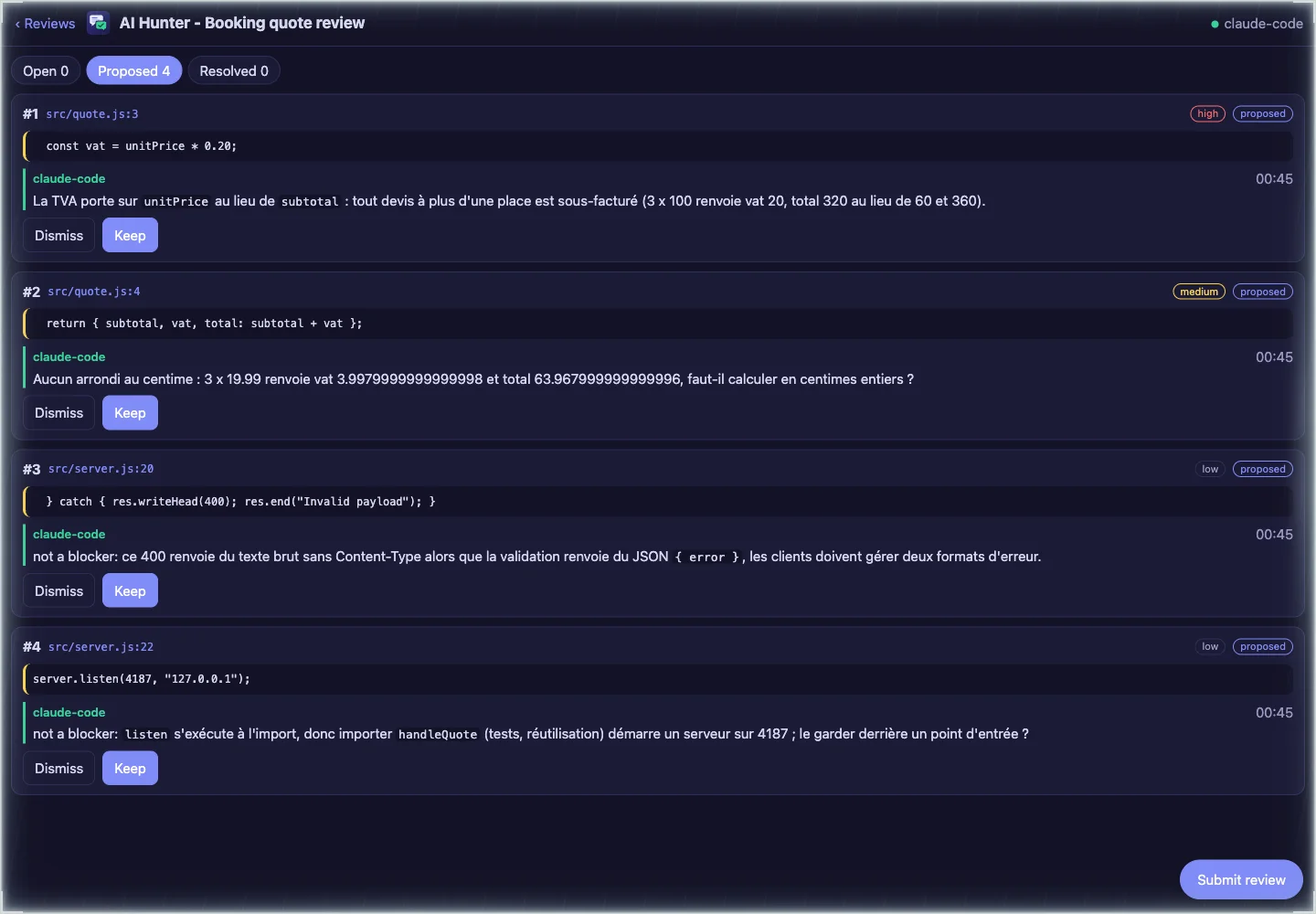
Taking ownership also means understanding the code you ask an agent to produce. Our first Co-Review test with Claude Code explores that review process through a calculation bug in a small demonstration application.
Code is becoming more accessible, but other assets are not keeping pace. A repository does not reproduce the data a service has accumulated, nor the integrations maintained with dozens of third-party tools. Nor does it reproduce service continuity, compliance, distribution or network effects. Above all, a SaaS can sell the fact that it takes operations off your hands, with availability and support commitments that should be checked in the contract.
In our analysis, this is where defensible value lies. A vendor whose price rests mainly on screens and standard features is more exposed than one that charges for reliability, data and taking on risk.
From seats to actions and outcomes
Vendors are already adapting their models. An agent can handle work without adding human users, which undermines the logic of per-seat pricing. Salesforce offers several billing models for Agentforce, including per-action or credit-based billing and another based on conversations. Intercom documents outcome-based pricing for Fin, with several outcome categories that do not boil down to a single rate.
Our guide to setting up Fin illustrates the practical questions this raises: source quality, handoff to a human and measuring outcomes.
Nothing indicates that open projects are behind these changes. Rather, they show that the unit of value is shifting: some services add pricing tied to work completed on top of per-user pricing. Per-seat pricing is being challenged, not abolished.
The rent is also moving to the cloud and the models
Replacing a license with an in-house application does not eliminate spending: it changes its nature. You pay for operations, inference, storage, security and maintenance. Ember illustrates this shift well. The team no longer pays a messaging vendor, but it pays an infrastructure provider and, if it enables agents, a model provider.
This is our central hypothesis: part of the value captured by applications could move to those who run the software and the agents. This is not sovereignty regained, but dependency redistributed.
The Cal.com paradox
One might conclude that AI is pushing everyone toward openness. Cal.com shows that this is not the case. The company announced on April 14, 2026 that it was closing the source code of its commercial product. It maintains Cal.diy under the MIT license, with a separate scope. The company cites AI-related security concerns. That is its justification, not a conclusion established by independent analysis.
One fact remains: the current version of Cal.com is not entirely open source. The episode is also a reminder that an open project has to fund its maintenance. A hosted version, reserved features, a license change for future versions: today’s free alternative can evolve. Finally, code that is merely visible must be distinguished from code under an open-source license, because they do not grant the same rights.
How to decide what to replace in your stack
The right unit of analysis is the use case, not the brand. The same tool can be easy to replace for a five-person team and indispensable for a legal department. The grid below is a qualitative editorial analysis, not a measurement.
| Exposure | Typical signals | Example use cases | First move |
|---|---|---|---|
| High, worth testing | Generic features, few integrations, exportable data, outages cause little disruption | Non-sensitive internal feedback form, simple tracking board | Short pilot on a limited scope |
| Intermediate | History, permissions and habits matter | Team messaging, project management, knowledge base | Test the migration of history and permissions first |
| Demanding substitution | Proprietary data, legal obligations, many stakeholders, high criticality | Payroll, accounting, critical systems, CRM shared with partners | Compare guarantees and responsibilities before considering a migration |
To compare, a simple calculation is enough: full replacement cost = migration + infrastructure + models + maintenance + controls + training + operational risk. Compare this total with the subscription over the same period and for the same functional scope. A comparison that leaves out any of these items artificially favors the in-house option.
Before any replacement, run a six-step mini-audit:
- Pick a single function, not an entire product.
- Check that the data can be exported in a usable format.
- Test the alternative on a non-critical sample.
- Assign one person to be responsible for maintenance.
- Check access rights and backups.
- Keep a way back to the original tool.
SaaS will have to justify what remains valuable
Ember will not replace Slack for everyone. Its significance lies elsewhere: it shows that team messaging can become software you host, and no longer just a subscription you choose. Combined with coding assistants and the open alternatives already available, this observation forces vendors to spell out what they are really selling.
Nothing justifies announcing the end of SaaS. Our reading is that generic features offer a vendor less protection, while reliability, data, integration and accountability carry more weight in the buying decision. Vendors that charge for these elements have a strong argument. Those that mainly sell screens will find it harder to justify their price to a customer who now knows they can try something else.
FAQ
Have Slack or Salesforce published their code?
No. Here, “getting open-sourced” refers to the emergence of a competing open implementation, such as Ember against Slack or Twenty against Salesforce. These vendors’ own code is not involved. Campfire, on the other hand, is a case of opening by its own vendor.
Is an open-source alternative free?
The license may be free, but that does not guarantee a total cost of zero. Hosting, storage, model calls, backups, updates and human time make up the real cost. Many projects also offer a commercial or hosted edition, with features missing from the community version.
Is a coding assistant enough to rebuild a SaaS?
For a prototype or a targeted internal tool, it can speed up the work, provided a human reviews the result. For a service that stays reliable over time, it replaces neither operations, nor security, nor maintenance. The available studies, from Anthropic as well as from METR, do not make it possible to put a figure on a general gain.
Which subscriptions should you review first?
Those that serve a generic function, with few integrations, easily exportable data and limited impact in case of an outage. Critical or regulated tools, or those shared with external partners, call for much more caution: their value often lies in what code alone cannot reproduce.
Related guides
Comparisons and guides covering adjacent topics.
Tools mentioned
Find the best AI tool
215 tools listed with features and pricing. Find the one that fits your needs.