
Rebuilding a monthly client report by hand means exporting, pasting, formatting and explaining the same data each month. If you automate data collection and the first draft, you get time back for what clients actually value: what changed, the evidence, what you will do next, who owns it, by when, and which decision the client must take. With only a few clients, an existing dashboard plus short manual commentary may be enough. Do not buy a new tool for a one-off export.
Quick picks
Three AI reporting platforms compared
 AgencyAnalytics
- Best for
- Agencies reporting SEO and PPC results to many clients who want simple per-client billing.
- Plan
- Core from 20 USD per client per month, billed annually. Unlimited data sources, reports, dashboards and staff accounts; 14-day trial.
- AI role
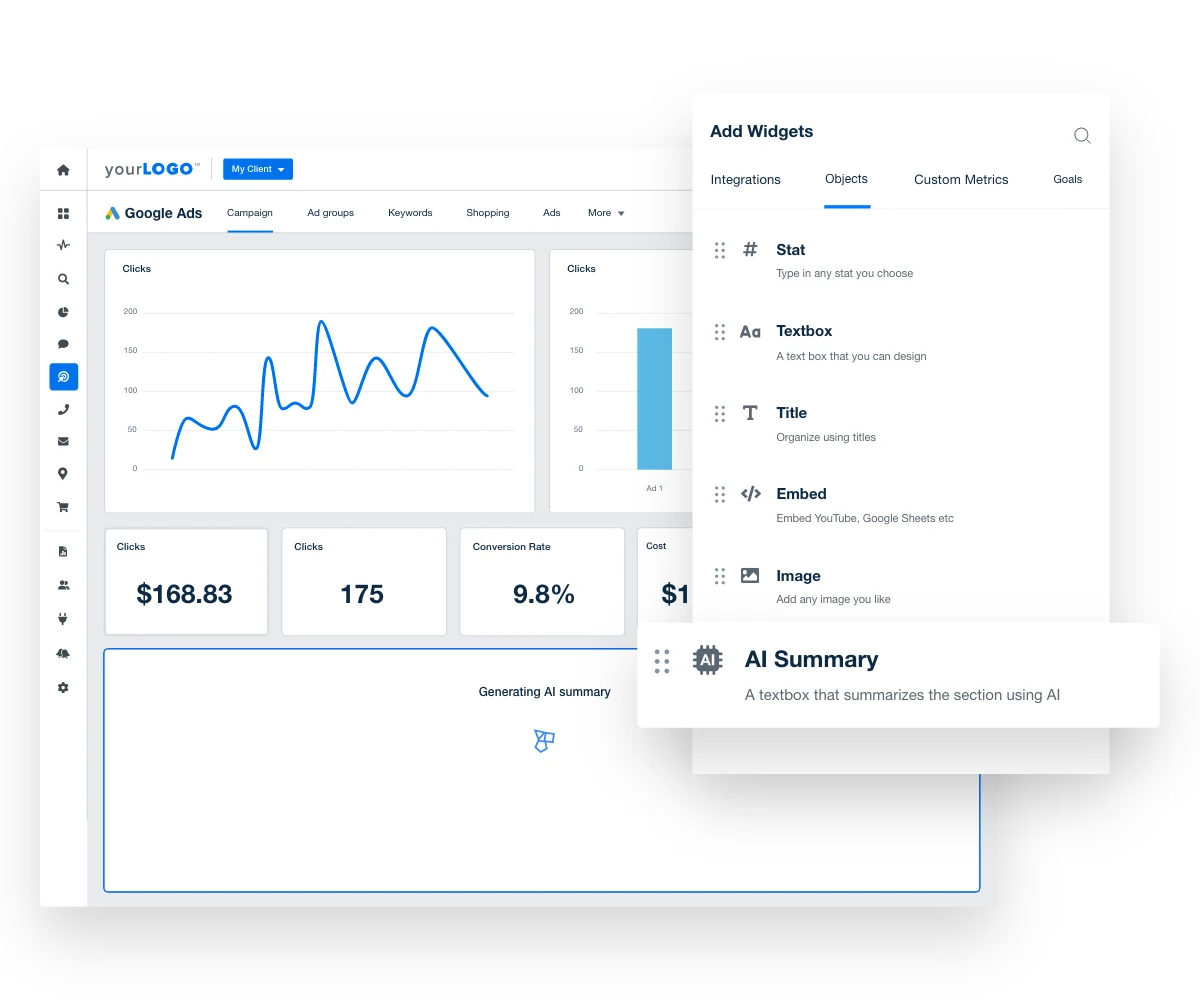
- Ask AI answers questions from client data and cites its source report; AI Summary drafts editable section summaries.
- Watch out
- Ask AI and AI Summary are included in Core. Check that your required connectors and metrics fit; validate summaries before delivery.
 Databox
- Best for
- Agencies tracking KPIs and goals across several client accounts, with questions answered from connected metrics.
- Plan
- Agency from 79 USD/month billed annually: 4 accounts, 20 sources, 300 AI credits/month, unlimited users. Each 20 USD/month pack adds 1 account, 5 sources, 50 credits. White label: 200 USD/month add-on.
- AI role
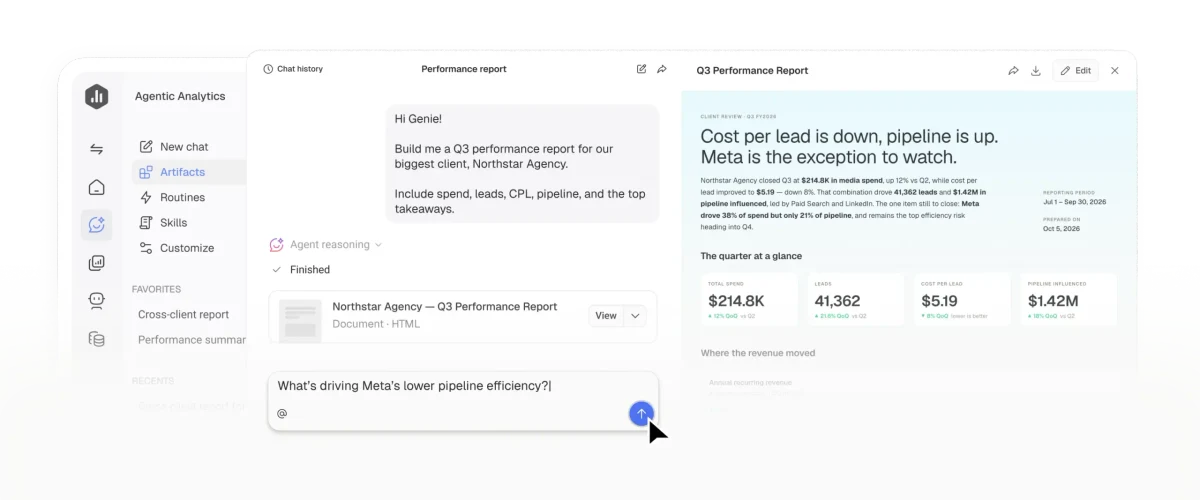
- Genie answers questions from connected metrics, writes performance summaries and supports cross-account reporting, with custom templates and bulk actions.
- Watch out
- AI credits come from a shared pool. Agents are marked Soon on pricing; branding and white label cost extra.
 Whatagraph
- Best for
- Agencies that blend many data sources and want one standardized report format across all clients.
- Plan
- Max from 812 USD/month billed annually; Prime on custom quote. Max includes data blends, white-label reports and scheduled PDF emails.
- AI role
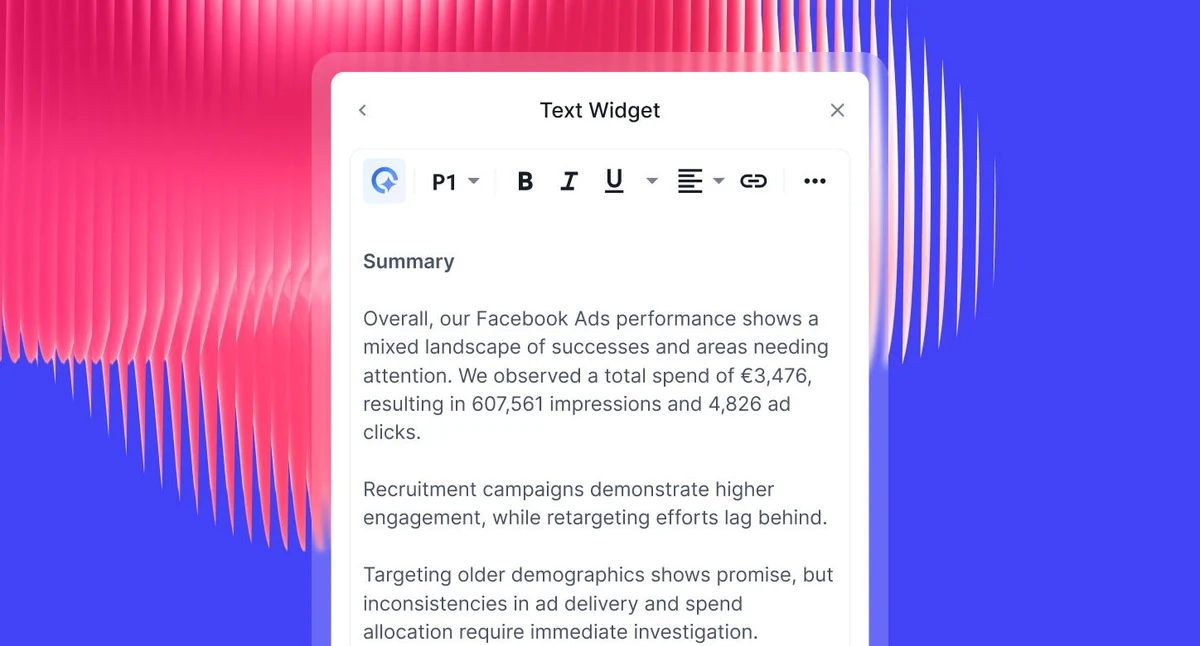
- Whatagraph IQ helps create and style reports, writes summaries and lets you chat with your data.
- Watch out
- Source capacity needs a quote. Custom domain, public API and BigQuery are not in Max; check Prime add-ons.
AgencyAnalytics: per-client reporting with a white-label portal
AgencyAnalytics bills per client and includes unlimited data sources, dashboards and staff accounts, with a white-label client portal. Core includes Ask AI and AI Summary. Ask AI cites its source report, and scheduled reports can notify you before delivery.
Pilot it on your two most typical SEO or PPC clients. Use the pre-delivery notification as a checkpoint: someone reads the AI Summary, fixes the wording and adds next actions before the report goes out. If per-client cost grows faster than revenue, compare it with an account-based plan.
Databox: cross-client KPI analysis and goals
Databox prices by accounts, sources and AI credits rather than per client report. Genie answers questions from connected metrics and drafts performance summaries. The free plan suits one user, not agency white-label delivery.
Before committing, count how many questions your team actually asks per client each month and map that to credits. Run the pilot with goals set for two clients, and decide early whether clients need your branding, because that add-on changes the budget significantly.
Whatagraph: standardized multi-source agency reports
Whatagraph Max includes data groups and blends, white-label reports, advanced integrations and scheduled PDF emails. Whatagraph IQ assists with report creation, styling, summaries and chat from your data.
Treat the published Max price as a floor, not a quote. Bring your real source list and client count to the sales call, ask what capacity is included, and pilot one standardized template on two clients before migrating every report you send.
1. Define one repeatable report
Before choosing software, fix what one client report must contain. Our fictional example: one client, three sources, five metrics, the same comparison every month.
- Use three sources, GA4, Google Ads and the CRM, and compare last month with the prior month in the same currency and timezone. Track five metrics only: spend, leads, qualified leads, won revenue and cost per qualified lead.
- Define a qualified lead with the client’s own rule, written down and approved by them. Do not let AI invent the definition or guess which leads count, because every later number and comment depends on it.
- Make the CRM the source of record for won revenue. Never add up the sales each ad network claims and present that as the CRM total. This report describes performance; it does not prove attribution between channels.
2. Verify the data before any AI summary
AI writes confidently about broken data. A short check before drafting protects the report and your credibility with the client.
- Check source freshness and disconnect warnings first. A missing value means unknown, not zero. Confirm that currency, timezone, filters and attribution window match the previous period, otherwise the comparison is meaningless even if the chart looks clean.
- Deduplicate transactions by ID before aggregating. When Google Ads, Meta and the CRM each claim the same sale, those conversions are not additive. Keep one count from the source of record and mention the platform claims separately.
- Separate observation, hypothesis and test. Clicks dropped is an observation; weak creatives is a hypothesis; a new creative test is the action. Attach a source and period to each claim so the client can trace it.
3. A reusable prompt for ChatGPT or Claude
If your platform’s AI is limited, a general assistant can draft commentary from an approved export. The prompt matters more than the tool.
- Paste an anonymized, approved export (metric, value, period, source, unit) plus your definitions. Ask for five sentences on observed changes with source and period, missing data, labelled hypotheses, and three actions with owner and deadline. Forbid invented figures, reasons or ROI; a zero previous value means undefined relative change.
- Fictional check: leads rose from 100 to 120, a 20% increase, while qualified leads fell from 20 to 18, minus 10%. A correct summary says more leads did not bring more qualified leads, and claims no cause.
- Optionally, Codex or Claude Code can check authorized sample CSV files for duplicate IDs, missing periods, mixed currencies and calculation consistency. This step is not required, and it must never make automatic changes to client campaigns.
4. Budget example: 10 clients, three sources each
A fictional licence comparison in USD with annual billing, before taxes and extras. These are different products, so similar prices do not mean equivalent features.
- AgencyAnalytics: 10 clients at 20 USD each comes to 200 USD per month billed annually, before taxes and extras. It is easy to forecast, and the cost rises one client at a time as you sign new accounts.
- Databox: the Agency base covers 4 accounts, and 6 packs bring you to 10 accounts, 50 sources and 600 credits, so 79 + 6 × 20 = 199 USD per month annually. With the 200 USD white-label add-on, that becomes 399 USD per month, not per year.
- Whatagraph: Max starts at 812 USD per month billed annually, a starting floor rather than a binding quote for 10 clients, so confirm source capacity. Annual billing is a commitment, not monthly cancellation. Pay more only if your report volume justifies the setup work.
5. Pilot one full reporting cycle
Run one real month before migrating everyone. The goal is a report the client reads and acts on, not a prettier export.
- Pick two representative clients, one of them with a visible change versus the previous period. Check all five metrics against their source, and review the first report manually before anything is sent to the client.
- Test client access, PDF and mobile legibility, the template and the report language. This is a suggested workflow, not a feature every product offers, and nothing should pause or change campaigns automatically.
- Measure preparation minutes, corrections needed and client questions answered, rather than promised savings. Keep a named data owner and a client-side approver. Automation should free attention for strategy, relationships and implementing the actions the client approved.
FAQ
What is the best client reporting software for a small agency?
The one that matches your reporting job. AgencyAnalytics suits per-client SEO and PPC reporting, Databox cross-client KPI analysis and goals, Whatagraph standardized multi-source reports. With few clients, a dashboard you already use plus short commentary may be enough.
What does AI actually add to client reporting?
AI drafts summaries, answers questions from connected data and helps spot changes. Its output still needs checking against source figures and context. Assign someone to correct the wording and turn useful observations into client-approved actions.
Can ChatGPT or Claude create a client report from exports?
Yes, for the commentary. Give an anonymized, approved export with metric, value, period, source and unit, plus your definitions. Ask for observed changes, missing data, labelled hypotheses and three owned actions, and forbid invented figures. Check every number.
Is the free Databox plan enough for an agency?
Rarely. The free plan covers one user, three sources, one dashboard, 50 AI credits per month and daily sync, without agency white label. It is useful for testing Genie on one client, not for delivering branded reports.
Dashboard or scheduled report: which should clients get?
Often both. A live dashboard answers day-to-day questions; a scheduled report fixes the period, adds commentary and records decisions. For a monthly review, the scheduled report with next actions, owners and dates gives the conversation a clear structure.
How does white label differ between these tools?
AgencyAnalytics includes a white-label client portal. Databox sells branding and white label as a separate add-on. Whatagraph Max includes white-label reports, but a custom domain is not part of Max. Check what clients will actually see during the trial.
How much does reporting software cost for 10 clients?
In our fictional example with annual billing: 200 USD per month for AgencyAnalytics, 199 USD for Databox or 399 USD with white label, and from 812 USD for Whatagraph Max, subject to quote. Taxes and extras are excluded.
Can an AI summary explain why results changed?
It can suggest hypotheses, not prove causes. A drop in clicks does not show that creatives are weak. Ask the AI to separate observations from hypotheses, cite source and period, and propose a test that confirms or rejects each explanation.
Sources · 23/10/2026
Features and pricing checked on official vendor pages on 23 October 2026; ratings from G2 product reviews.
- AgencyAnalytics · Source · G2
- Databox · Source · G2
- Whatagraph · Source · G2
Related guides
Reporting runs better when the rest of the agency is organized. Continue with our guides on an AI internal knowledge base, client onboarding and time tracking.
 AI internal knowledge base assistants for small teams 2026
 AI Client Onboarding for Agencies: 3 Tools Compared (2026)
 AI Time Tracking for Agencies and Consultants: 2026 Guide
Find the best AI tool
215 tools listed with features and pricing. Find the one that fits your needs.